13 May
2026
Energeks
What does "dry‑type transformer" mean, and why is it not always cast‑resin?
A dry‑type transformer is not one type of device, but a group of transformers without insulating liquid. It can have air insulation, open‑wound windings, VPI impregnation, composite insulation, or full cast‑resin encapsulation with epoxy resin. The choice depends on the working environment, humidity, dust levels, fire safety requirements, cooling method, and ease of servicing.
In the industry, a mental shortcut very often works: dry means cast‑resin.
Someone says "dry‑type transformer", and the other person immediately pictures windings cast up to the brim with epoxy resin. Solid, shiny, compact coils. No oil. No tank. No risk of leakage. Case closed.
Only technically, the case is not closed at all.
A dry‑type transformer is not one technology. It is a whole family of constructions where insulation and cooling are not based on an insulating liquid. There is no mineral oil or ester to remove heat while also providing insulation. Heat is dissipated mainly by air, and the winding insulation can be achieved in several ways.
And this is where the most interesting part begins.
A dry transformer can have air insulation.
A dry transformer can be VPI‑impregnated.
A dry transformer can be of the open‑wound type.
A dry transformer can have composite insulation.
A dry transformer can finally be cast‑resin – the most well‑known type – cast with epoxy resin.
Each of these belongs to the world of dry‑type transformers, but not all behave the same. They differ in resistance to moisture, dust, temperature, vibration, contamination, overloads, cooling method, and ease of servicing.
Therefore, the question "which dry‑type transformer to choose" should not start with the price.
It should start with the place of work.
Will the transformer stand in a clean technical room?
In an industrial hall with dust?
In a public building?
In an indoor substation? Near people?
In a humid environment?
In a place where low noise level matters?
Where any failure means costly downtime?
Only then does it make sense to discuss whether epoxy, VPI, air insulation or a special construction will be best.
This text organises the subject without unnecessary hype.
It will cover what a dry‑type transformer really means, what its types are, how air insulation differs from VPI and cast‑resin, where open‑wound works, and why epoxy resin is not always the only sensible answer.
Reading time: ~ 8 minutes
Simply put, a dry‑type transformer is a transformer that is not immersed in an insulating liquid. In an oil‑filled transformer, the windings and core operate in oil or another insulating fluid. In a dry‑type transformer, this fluid is absent.
But the absence of oil does not mean the absence of insulation. This is very important.
The insulation must still withstand operating voltages, overvoltages, heating, ageing, vibrations, and mechanical stresses during short circuits. The difference is that this function is taken over by solid materials, air, varnishes, resins, insulating tapes, spacers, distancing elements, impregnation systems, and the design of cooling ducts.
That is why two dry‑type transformers of the same power can look similar in a table but behave completely differently in operation.
One will dissipate heat better but tolerate contamination less well.
Another will be more resistant to moisture but heavier and more expensive.
A third will be easier to service but will require a clean, well‑ventilated room.
A fourth will perform where a standard design would age too quickly due to chemicals, vibrations or elevated temperatures.
It is a bit like technical clothing. A sports shirt, a softshell, a rain jacket and a work coverall can all serve to protect the body, but no sensible person treats them as interchangeable. Each solution makes sense in a different environment.
The same is true for dry‑type transformers.
Every epoxy cast‑resin transformer is a dry‑type transformer, but not every dry‑type transformer is epoxy.
This sentence is worth remembering, because it resolves half of the industry misunderstandings.
Epoxy, i.e. cast‑resin, is only one type of dry‑type transformer.
Very popular, often very good, but not the only one.
If a request for quotation only says "dry‑type transformer" without specifying the winding technology, offers for different constructions may appear.
One company will propose cast‑resin – a dry transformer with windings cast in resin.
Another will propose VPI – a dry transformer with vacuum‑pressure impregnated windings.
A third will propose an open‑wound construction – a dry transformer with open, ventilated windings.
A fourth, most interestingly, might propose dip and bake – a dry transformer with windings impregnated by dipping and baked in an oven.
Formally, all will be dry‑type transformers, but technically they will not be the same product.
This is where the risk of comparing apples to oranges begins.
The price may differ not because someone exaggerated their margin, but because different insulation systems, different environmental resistances, different cooling methods and different capabilities for working in harsh conditions are being compared.
Therefore, in a well‑prepared specification, it is not enough to write "dry‑type transformer 1000 kVA. It is worth specifying the winding technology, environmental, climatic and fire classes, cooling method, noise level, degree of protection of the enclosure, ambient conditions, room ventilation, temperature sensors and operational requirements.
A dry‑type transformer does not work in a vacuum.
It works in a specific building, a specific substation, a specific hall and specific air. And the air can be clean, dry and calm. Or it can carry moisture, dust, salt, chemical vapours and everything that electrical insulation very much dislikes.
The simplest variant is a dry‑type transformer with air insulation.
In such a construction, air remains one of the basic elements of the insulation and cooling system. The windings are not fully encapsulated in a solid resin block. They are usually protected with an insulating varnish or resin in an impregnation process, for example by VPI or the simpler dip and bake method.
In practice, this means the winding is protected but not enclosed in a thick, solid mass of resin.
This gives several important advantages. Such a transformer can be lighter. It can dissipate heat well because air has easier access to the winding surfaces. It can also be easier to inspect and service because the construction is more open.
But there is another side.
If the working insulation largely remains air, the quality of that air becomes enormously important. Dust, moisture, conductive contaminants, aggressive chemical compounds and condensation can become real problems. This type of transformer needs a clean, dry and controlled environment.
This is not a flaw in itself.
It is simply a condition for correct application.
In a clean technical room, such a construction can work very well.
In a harsh industrial hall where dust is airborne and temperature and humidity change dynamically, much more caution is needed.
A transformer with air insulation is like a device that breathes well.
But since it breathes, it should not breathe dirt.
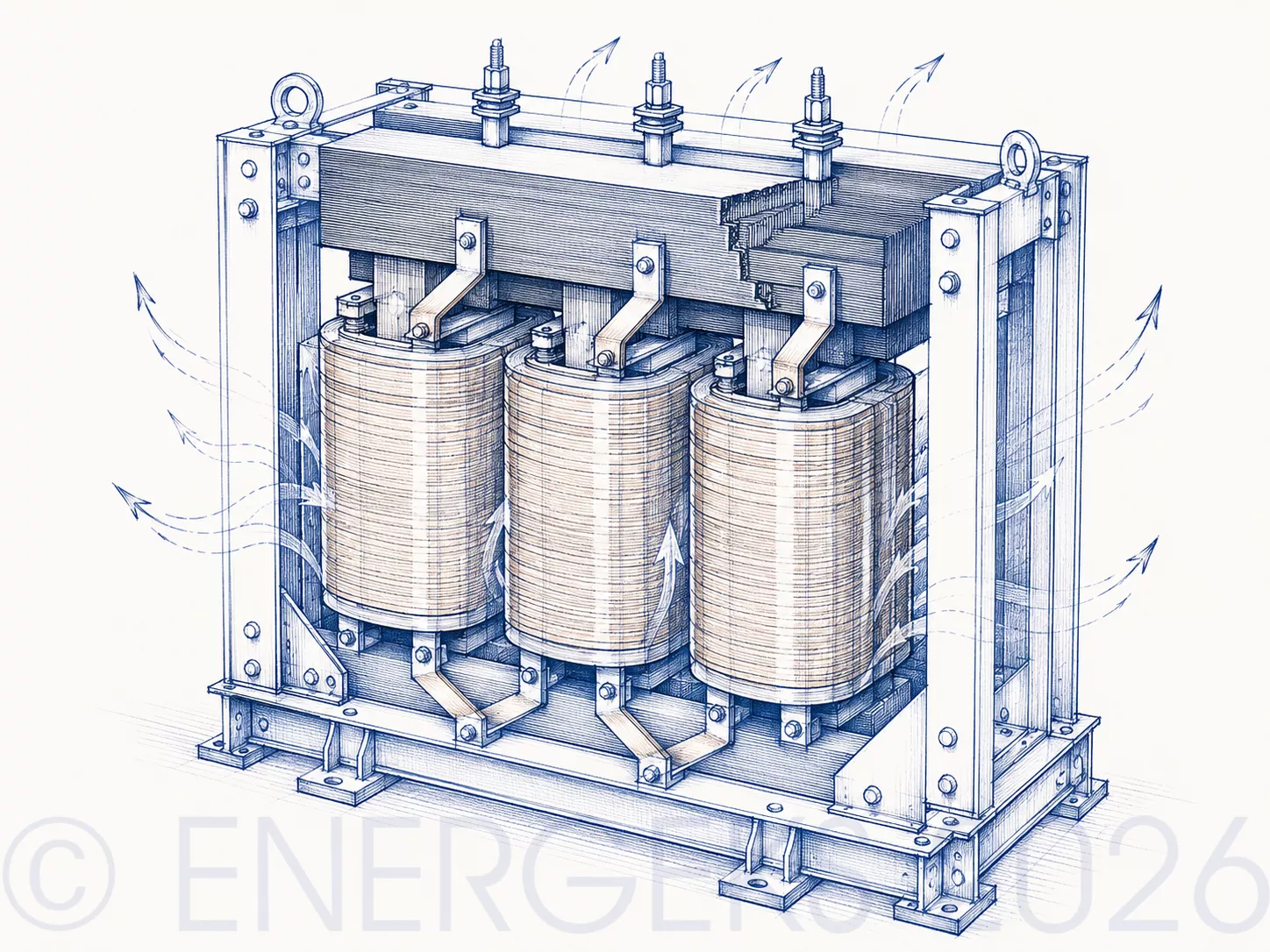
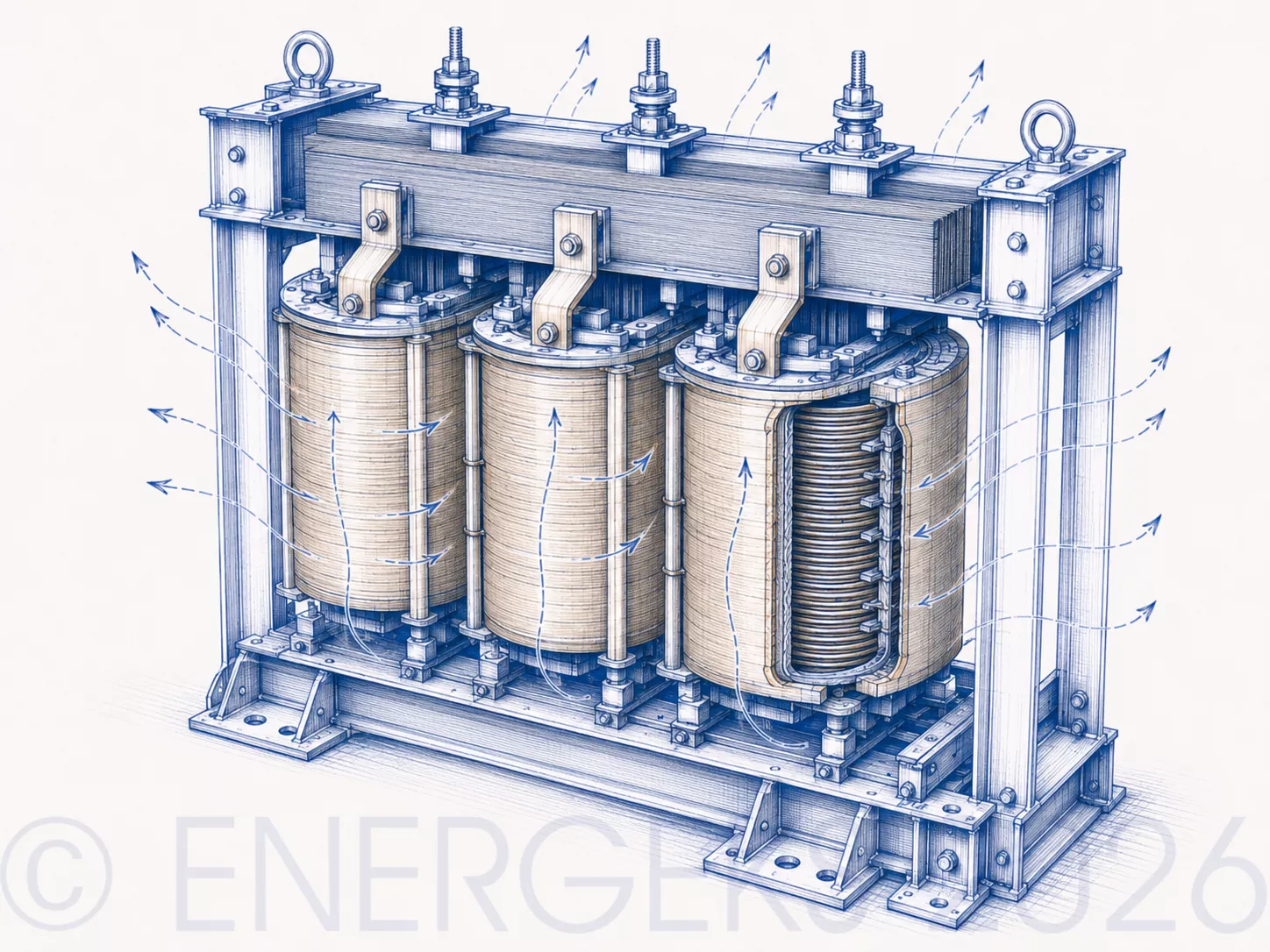
The illustration shows a dry transformer construction where the spaces between windings, insulators and supporting elements are clearly visible. This explains the principle of a dry transformer with air insulation: air participates in cooling and electrical separation, and the windings are not completely enclosed in a solid resin mass. Such a transformer likes clean, dry technical rooms.
VPI stands for Vacuum Pressure Impregnation.
In this technology, the windings are saturated with resin or insulating varnish in a controlled process. First, air is removed from the spaces between turns, then the impregnating material is introduced under pressure. After curing, a structure is formed that is stronger, more stable and better protected than with simple varnishing.
The key point, however, is that VPI does not create the same effect as cast‑resin encapsulation.
In a VPI transformer, the windings are impregnated with insulation but are not completely sealed in a solid resin block. There is no uniform, massive epoxy block. Rather, we have an impregnated, reinforced and protected structure that still retains a more open character.
This gives an interesting compromise.
VPI can be more cost‑effective than cast‑resin.
It can dissipate heat well because the winding is not covered by a thick layer of resin. It can be lighter and more flexible in certain applications. It works well in many technical buildings, industrial facilities, switchgear rooms and applications where conditions are relatively controlled.
However, it is not a technology for every environment.
If the transformer is to operate in a place with high humidity, in air with conductive dust, in a chemical atmosphere or in an area exposed to salt, you need to check very carefully whether VPI is sufficient. Sometimes it will be. Sometimes VPE, cast‑resin or a completely different solution will be better.
Simply put: VPI is a reasonable compromise between price, cooling and resistance. But like any compromise, it works best when you know the operating conditions well.
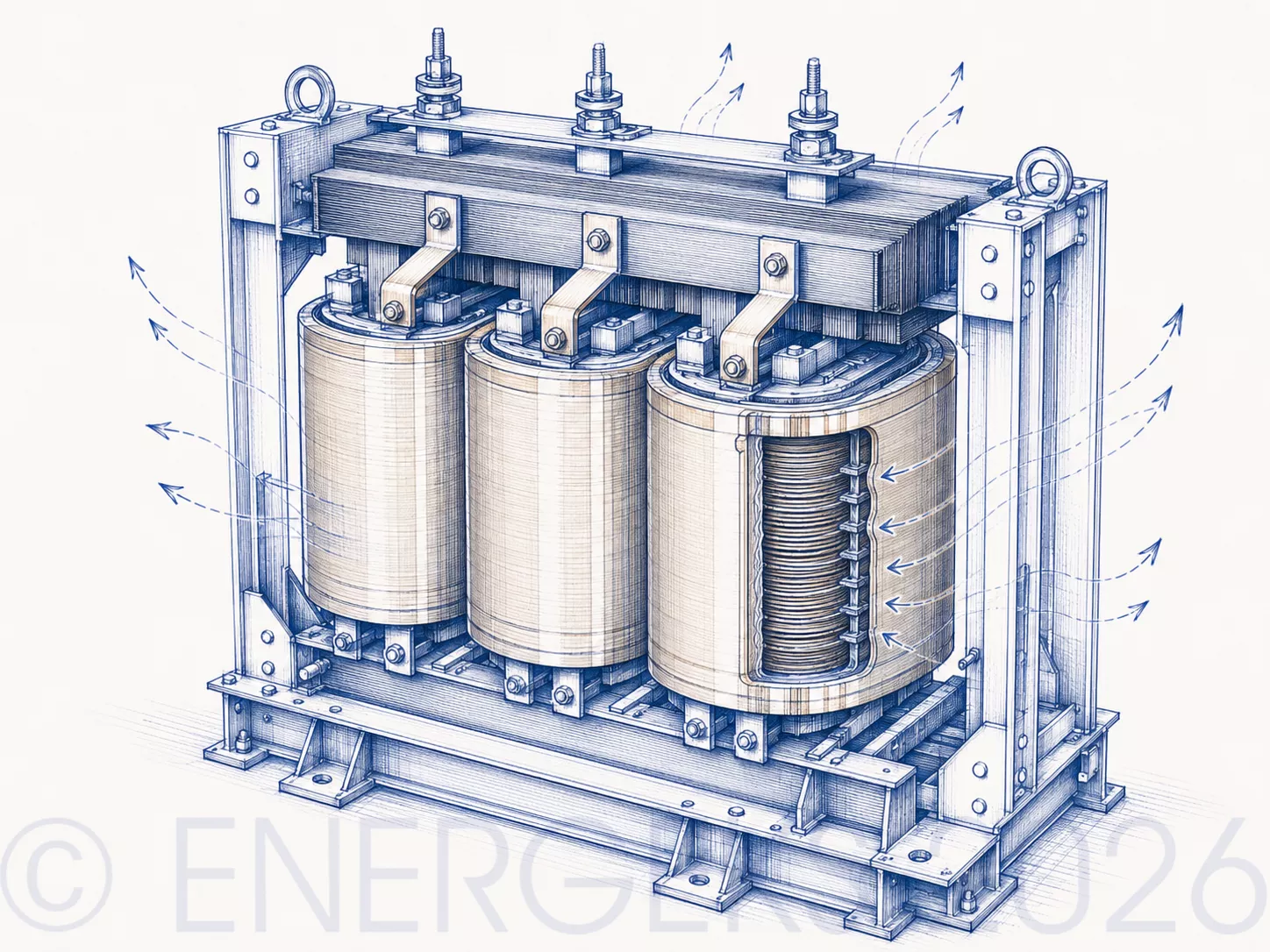
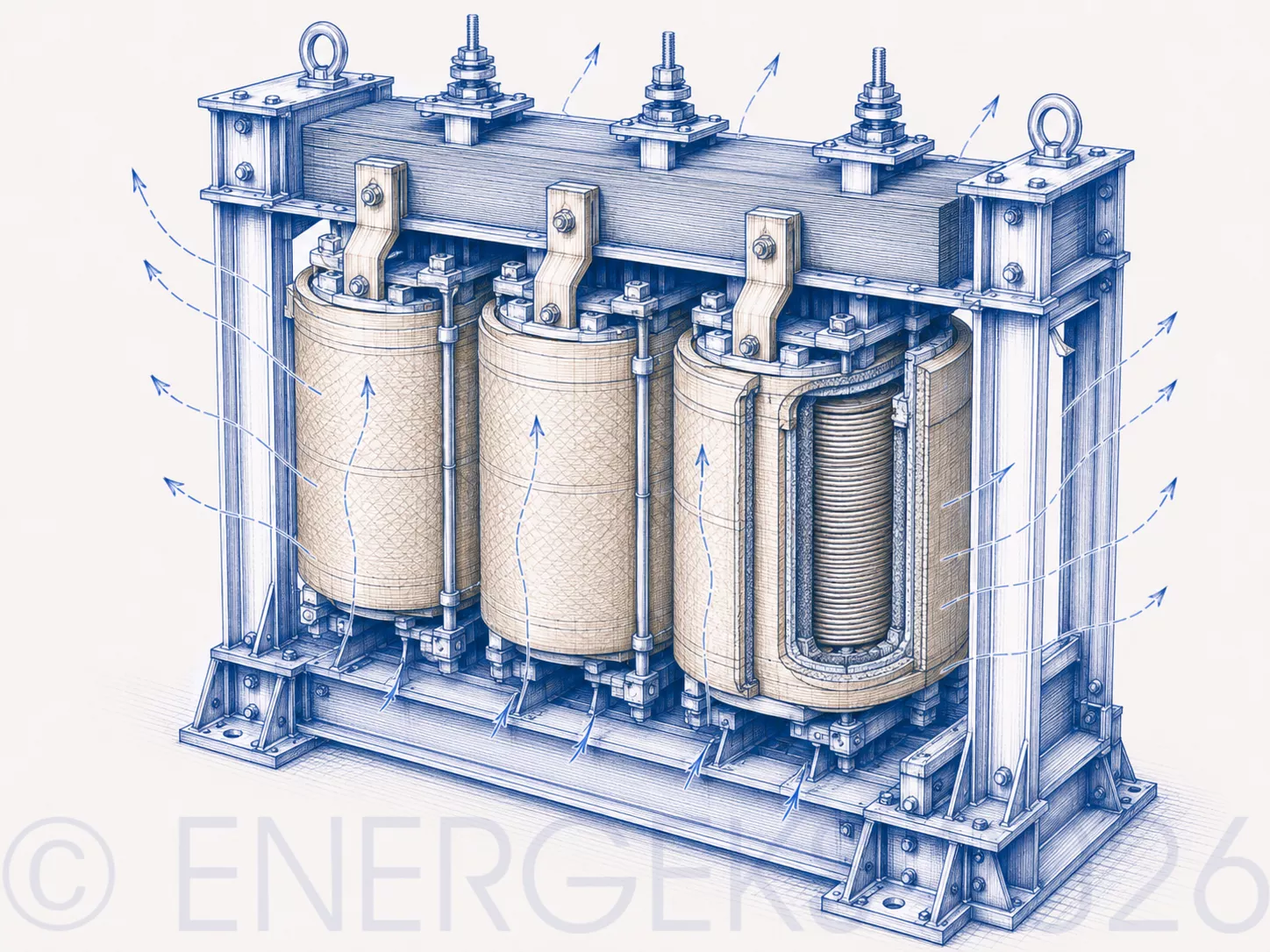
he illustration shows a dry transformer with visible windings, supporting frame and insulators, which fits the VPI technology well. In a VPI transformer, the windings are saturated with varnish or resin in a vacuum‑pressure impregnation process, but are not completely cast in resin like cast‑resin. This gives a good compromise between insulation protection, cooling and cost.
Open‑wound is a construction with open, air‑cooled windings.
Sometimes such transformers are described as AN (air natural) when cooling is by natural air movement without fans. In other cases, forced cooling (AF) with fans may appear.
In an open‑wound transformer, the windings are visible, ventilated and protected by electrical insulating materials. They are not enclosed in a resin mass.
Airflow is very important here, because it is responsible for heat dissipation.
The greatest advantage is effective cooling.
The open construction allows air to flow through the ducts and around the windings. This allows the transformer to dissipate heat efficiently to the surroundings. An additional advantage can be lower weight and simpler inspection.
The biggest limitation is sensitivity to the environment.
Open‑wound does not like moisture, dust, contamination or aggressive air.
In a clean indoor environment it can work very well. In a place where dust settles on the insulation, moisture creates conductive paths, and ventilation draws contaminants from the hall, problems can begin.
This solution is rather for interiors with controlled conditions.
Not for a random corner of a hall where "it will be fine".
In power engineering, "it will be fine" often later means "why is the protection tripping" or "why is the temperature rising faster than in the documentation".
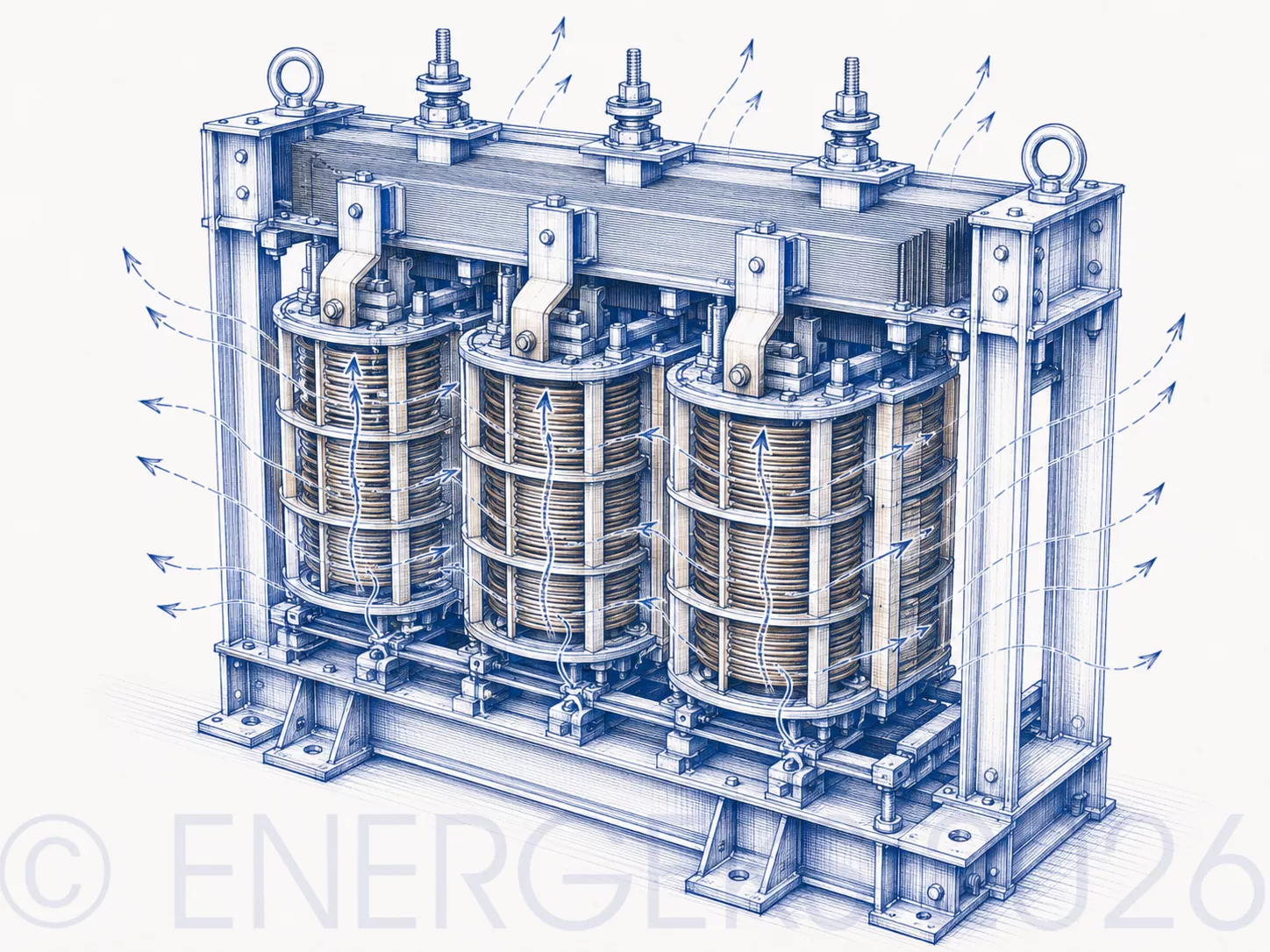
The illustration shows a dry transformer with strongly exposed winding elements, insulators and air ducts. This captures the idea of an open‑wound construction – a transformer with open, ventilated windings. Such a design dissipates heat very well because air can flow more freely around the active parts. The price for this openness is simple: the transformer does not like moisture, dust and aggressive environments. It is a more precise technical piece of equipment than a "shovel‑for‑everything".
Dip and bake is a simpler method of winding impregnation.
The windings are dipped in varnish or insulating resin, then dried and cured in an oven. Hence the name: dip and bake.
This is a well‑known, relatively simple method used in various electrical devices.
Compared to VPI, however, it usually has a lower ability to penetrate deeply into the winding structure. There is no such intensive air removal and pressure‑driven material injection.
Does this mean dip and bake is bad? No. It means it has its place.
It can be used in less demanding applications, at lower powers, in auxiliary devices, or where operating conditions are stable and do not require a higher level of protection. However, if the transformer is to operate in a more difficult environment, VPI or cast‑resin may provide a greater safety margin.
In practice, the difference between dip and bake and VPI is like the difference between painting wood on the surface and deep impregnation. Both protect. But not to the same degree.
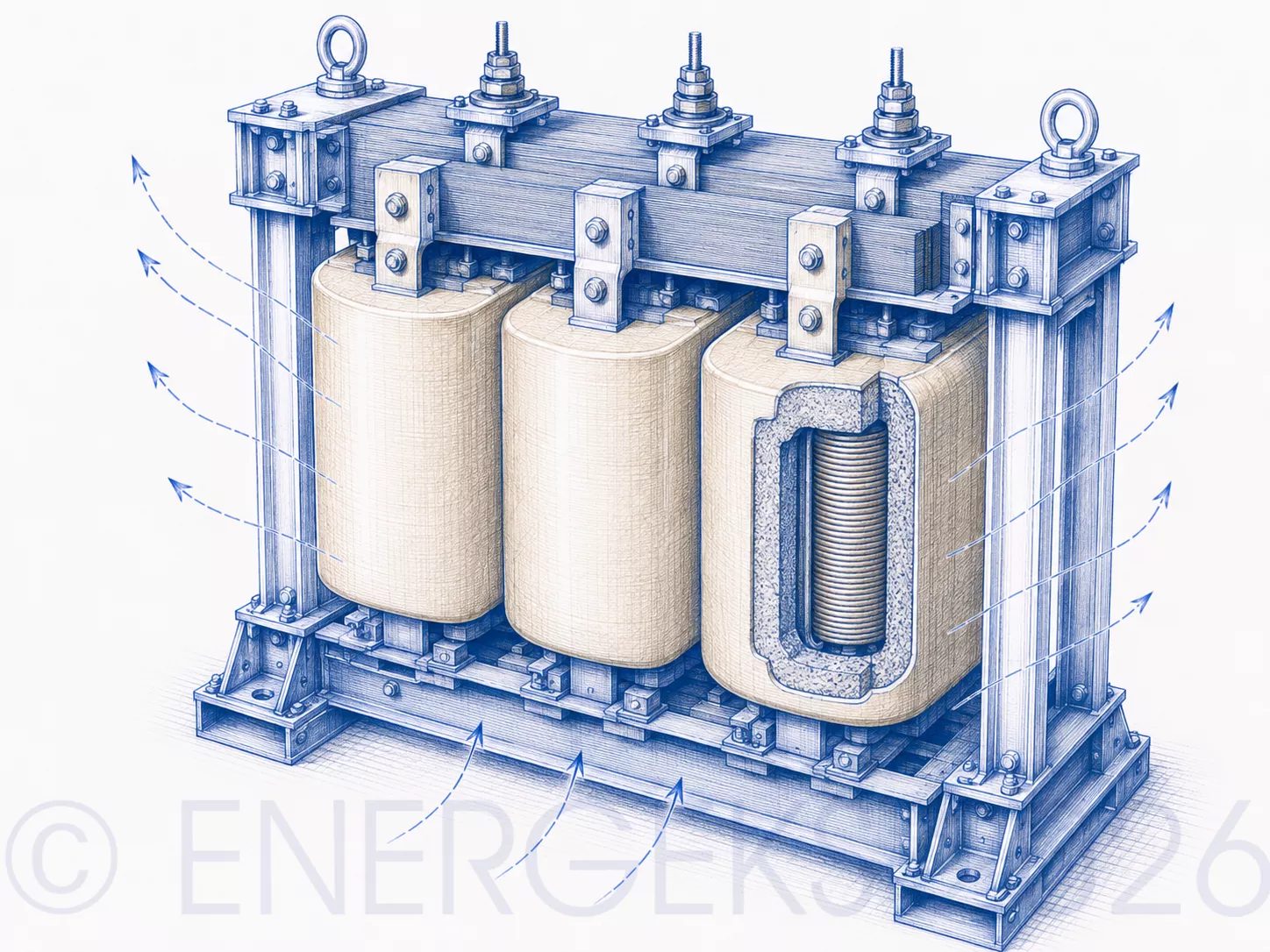
Here we see a simplified representation of a dry transformer in a technical view that well illustrates the dip and bake method: the windings are protected by insulating material, but do not form a solid, full resin block like cast‑resin. In this technology, the windings are dipped in varnish or resin and then baked in an oven. The result is simpler, lighter and more economical, provided the transformer works in a clean and predictable environment.
Cast‑resin, an epoxy‑cast transformer, is the most recognisable type of dry transformer. In this construction, the windings are cast in a resin medium which, after curing, forms a compact, mechanical and dielectric shield.
This is the type that many people have in mind when they say "dry‑type resin transformer".
Its greatest advantage is resistance. Epoxy resin protects the windings against moisture, contamination and mechanical damage. The construction is stable, compact and performs well in facilities where fire safety, absence of insulating liquid and operation inside a building are very important.
Such a transformer is often chosen for commercial buildings, hospitals, data centres, production halls, urban infrastructure, indoor substations, public buildings and installations where the risk of oil leakage would be hard to accept.
But cast‑resin is not magic ;-)
It is usually heavier and more expensive than simpler dry constructions.
The thick resin layer increases resistance but can also affect heat dissipation. Servicing the windings is more difficult because the coil is not open.
If serious damage occurs, repair can be less flexible than in more accessible constructions.
Therefore, a cast‑resin transformer is often a very good choice, but not always the optimal choice.
If the environment is clean, dry and controlled, and fire safety requirements are not particularly strict, VPI may be technically sufficient and economically sensible.
If the environment is very harsh, just the word "cast‑resin" does not exempt you from analysing environmental and climatic classes, enclosure, ventilation and the manufacturer's documentation.
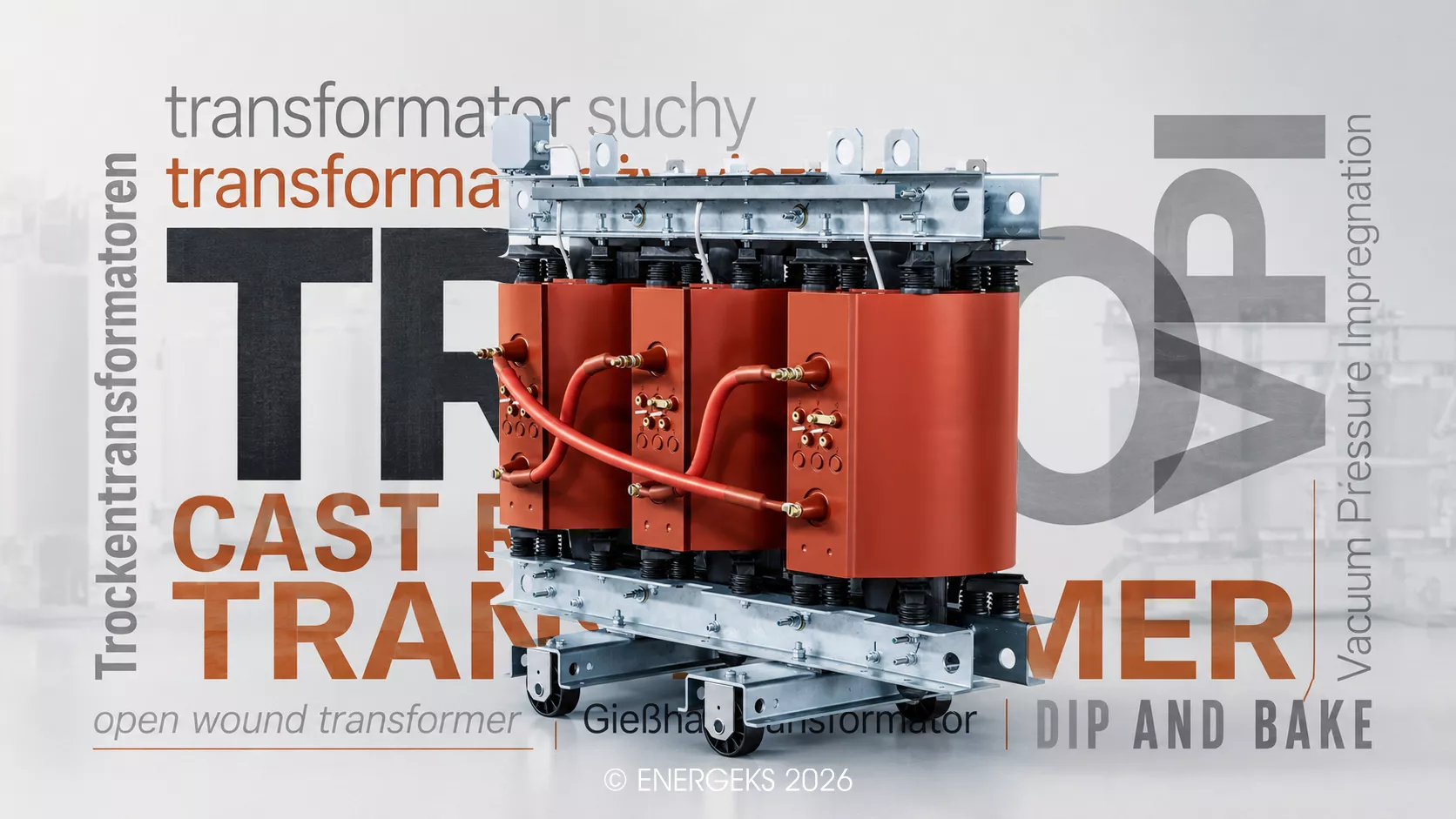
The illustration shows a cast‑resin dry transformer – a construction with massive resin‑encapsulated windings. The red, compact winding blocks show what is most important in this technology: high protection against moisture, contamination and mechanical damage. This solution makes sense where the transformer cannot be a delicate princess of the infrastructure but must work calmly in a building, indoor substation or facility with higher safety requirements.
There are also dry transformers with composite insulation other than classical epoxy resin.
These can be solutions based on polyurethane resins, silicone resins or other special materials. They are used where standard solutions do not fully match the operating conditions.
This is a niche, but technically very interesting.
Such constructions can make sense in environments with elevated temperatures, strong vibrations, special chemical requirements, or where a certain flexibility of the insulating material is needed. It is not always about the insulation being as hard as possible. Sometimes it is more important that it withstands stresses, thermal cycles, vibrations or contact with a specific environment well.
In practice, such solutions require detailed agreement with the manufacturer. They are not chosen on the basis of "let's take something unusual because it sounds modern". They are chosen when the application truly requires it.
It is a bit like specialised tools. Most screws do not need to be turned with surgical instruments. But when you encounter an unusual problem, an ordinary wrench may not be enough.
The diagram presents a dry transformer as a modular construction where the windings, insulators and metal frame form a coherent system resistant to operation in demanding conditions. Such an image fits a dry transformer with composite insulation, where insulating materials are selected not only for voltage but also for temperature, vibration and chemical environment. It is a technology for situations where standard insulation says "I'm only here for a while", but the project needs something more robust.
In buildings, the topic of dry‑type transformers appears particularly often. The reason is simple. The absence of insulating liquid makes design easier in places where the transformer operates close to people, utility rooms, technical installations and high‑value infrastructure.
But not all buildings are the same.
In a clean, well‑ventilated technical room where humidity is controlled and dust is minimal, an air‑insulated or VPI transformer can be a sensible solution. It can dissipate heat well, be easy to inspect and cost‑effective.
In a building with high safety requirements – for example a hospital, data centre, shopping mall or infrastructure facility – a cast‑resin epoxy transformer can provide greater operational peace of mind, especially when resistance to moisture, contamination and limitation of fire risks are important.
In an industrial building, you need to look even more broadly. Is there dust in the air? Is it conductive? Is the transformer room separated from the production process? Does the ventilation draw clean air or air from the hall? Are there vibrations? Are there temperature spikes? Can condensation occur in winter?
Sometimes the difference between a good and a bad choice lies not in the transformer itself, but in the room where it is to operate.
A dry‑type transformer needs air. But not just any air.
In dry‑type transformers, heat must be dissipated to the surroundings. Most often by air. And this is a topic that is often underestimated at the purchase stage.
A transformer can have natural cooling, designated AN. This means that air flows by natural convection. Warm air rises, cooler air flows in from below, and the transformer dissipates heat to the room.
It can also have forced cooling, designated AF. Then fans support the airflow, increasing the cooling capacity and allowing temporary increases in load or improved thermal conditions.
Only a fan does not solve everything.
If the room is too small, poorly ventilated or hot, the fan will just mix warm air with even warmer air. If the air is dusty, the fan can deposit contaminants on the windings more quickly. If the ventilation grilles are poorly sized, the transformer may operate at a higher temperature than assumed.
And higher temperature means faster insulation ageing.
Insulation does not usually fail spectacularly on the first day. It ages quietly. Day after day. Cycle after cycle. Overload after overload. And then comes the moment when the system no longer has a margin.
Therefore, with dry‑type transformers you need to ask not only about the rated power, but also about losses, ventilation, ambient temperature, permissible overloads and how the winding temperature is monitored.
The biggest mistake when choosing a dry‑type transformer is thinking that because there is no oil, the environmental problem is smaller.
Sometimes it is smaller. But it does not disappear.
A dry‑type transformer can be very sensitive to the air that surrounds it. If the air is clean and dry, the situation is comfortable. If it contains dust, moisture, salt, metal particles, chemical vapours or conductive contaminants, the insulation has a much more difficult task.
In a cast‑resin transformer, the windings are better protected by the resin. In VPI, the protection is good but less massive. In open‑wound, the protection is more dependent on the cleanliness and stability of the environment. In composite solutions, everything depends on the specific material and purpose.
Therefore, environmental conditions are one of the most important selection criteria.
It is worth checking whether condensation can occur. Whether the room will be heated. Whether the station doors open directly to the outside. Whether the transformer will be periodically switched off, which can promote moisture absorption during temperature changes. Whether there are production processes nearby that generate dust or fumes. Whether the enclosure has the appropriate degree of protection but at the same time does not excessively restrict cooling.
There is no sense in buying a transformer resistant to everything if it works in ideal conditions. But there is even less sense in buying a more delicate construction if the environment is harsh.
In dry‑type transformers, construction differences also affect service.
Open, air‑insulated and VPI constructions can be easier to inspect. More elements are visible. It is easier to assess contamination, hot spots, signs of partial discharges, the condition of the insulation surface and mechanical damage. In some cases, cleaning may also be easier.
Cast‑resin is more enclosed. This gives protection but limits access. If the winding is embedded in resin, it cannot be treated the same way as an open construction. In the event of serious damage, repair may be difficult or economically unviable.
This does not mean that cast‑resin is worse. It means it is different.
In many applications, higher resistance and lower environmental risk are more important than easier access to the winding. In other cases, service accessibility may be very important, especially when the transformer operates in a less critical application but requires regular maintenance.
Selecting a transformer is always a trade‑off. More protection may mean less access. More openness may mean better cooling but greater sensitivity to dirt. A lower purchase price may mean higher requirements for the room.
There is no free lunch. There is only a well‑calculated lunch.
If the transformer is to operate in a clean, dry, well‑ventilated room and the application does not require high environmental resistance, an air‑insulated, open‑wound or VPI construction can be considered. Such solutions can be lighter, cost‑effective and thermally efficient.
If the environment is still controlled but the investor expects better winding protection and greater insulation stability, VPI is often a very sensible compromise. It gives better impregnation than simple varnishing and can perform well in industry and technical buildings.
If there is higher humidity, risk of contamination, higher safety requirements, or the transformer is to operate in a facility where reliability and resistance are particularly important, cast‑resin should be considered. This solution is more expensive and heavier, but often gives a greater safety margin.
If the application is unusual, for example involving high temperature, vibrations or a specific chemical environment, composite insulation or special designs agreed with the manufacturer may make sense.
The most important thing is not to select a transformer by its name alone.
"Dry" only tells you that there is no insulating liquid. It does not tell you how the windings are protected. It does not tell you how the transformer will withstand dust. It does not tell you how it will cope with moisture. It does not tell you whether it will be easy to service. It does not tell you whether it will be cost‑optimal.
That is just the beginning of the conversation.
The first mistake is assuming that dry means cast‑resin.
This leads to misunderstandings in offers, tenders and technical discussions.
The second mistake is comparing only power and price.
A 1000 kVA VPI transformer and a 1000 kVA cast‑resin transformer can have completely different properties. Power alone is not enough.
The third mistake is ignoring ventilation.
A dry‑type transformer dissipates heat to the air. If the room does not remove that heat, the problem will return as temperature, alarms and faster insulation ageing.
The fourth mistake is underestimating dust.
Dust in a house is annoying. Dust on electrical insulation can be much more serious, especially if it contains conductive particles or binds moisture.
The fifth mistake is choosing on the basis of "take the cheapest dry".
The cheapest variant may be good if it fits the conditions. If it does not, it becomes an expensive compromise.
The sixth mistake is not talking about service.
A transformer is supposed to work for years. Access, cleaning, temperature measurement, sensors, inspections and documentation are part of the real cost of ownership.
First, define the working environment.
Is it clean, dry and stable, or does moisture, dust, aggressive air or condensation risk occur?
Then, define the safety requirements.
Does the transformer operate in a building, near people, in critical infrastructure, in a public facility, in a production plant or in a separate station?
Next, check the thermal conditions. What is the ambient temperature? How does the ventilation work? What are the transformer losses? Is airflow provided for? Will the enclosure restrict cooling?
Only then comes the technology choice.
If conditions are mild, open‑wound, air‑insulated or VPI can be considered.
If conditions are moderately demanding, VPI often makes very good sense. If the environment is harsher or safety requirements are high, cast‑resin may be more appropriate.
If the application is special, composite insulation or a custom design must be considered.
Finally, price – but not as the only criterion.
Price should be compared only when comparing solutions with similar purpose and similar levels of resistance.
Otherwise, the tender table looks elegant, but the decision may be technically random.
Is every dry‑type transformer cast‑resin?
No. Every cast‑resin transformer is a dry‑type transformer, but not every dry‑type transformer is cast‑resin. Dry means no oil or other insulating liquid. The windings can be protected by air, varnish, VPI impregnation, composite insulation or full epoxy encapsulation.
What is the difference between a VPI and a cast‑resin transformer?
A VPI transformer has windings impregnated with varnish or resin in a vacuum‑pressure process. A cast‑resin transformer has windings fully encapsulated in epoxy resin. VPI usually dissipates heat better and can be more cost‑effective. Cast‑resin gives higher protection against moisture and contamination but is heavier, more expensive and harder to repair.
When is a VPI dry‑type transformer a good choice?
A VPI transformer is a good choice when it operates in a clean, dry, well‑ventilated technical room. It is a reasonable compromise between price, cooling and resistance. It works well in many buildings, industrial plants and installations with controlled operating conditions.
When is a cast‑resin epoxy transformer better?
A cast‑resin transformer is a better choice where higher resistance to moisture, contamination and fire safety requirements matter. It fits indoor substations, public buildings, data centres, hospitals, shopping malls, production halls and facilities where operational stability is highly valued.
What is an open‑wound dry‑type transformer?
An open‑wound transformer is a dry transformer with open, ventilated windings. It dissipates heat very well but is more sensitive to moisture, dust and contamination. It works best in clean, dry, controlled technical rooms.
Which dry‑type transformer to choose for a building?
For a building, the transformer should be selected after analysing the working conditions. In a clean technical room, VPI or an air‑insulated construction may suffice. In a facility with higher humidity, risk of contamination or high safety requirements, a cast‑resin transformer more often makes sense.
A dry‑type transformer is not only the one cast to the brim with epoxy resin.
That is a convenient mental shortcut, but technically too narrow for this whole family of devices.
Dry primarily means the absence of insulating liquid.
It does not mean one single winding technology.
The simplest constructions use air insulation and varnish or resin impregnation.
VPI strengthens the windings through vacuum‑pressure impregnation.
Open‑wound gives very good cooling but requires a clean environment.
Composite insulations make sense in special conditions.
Cast‑resin provides high resistance thanks to full epoxy encapsulation, but usually means higher price, greater weight and more difficult service.
Therefore, the selection of a dry‑type transformer starts with one practical question:
Where will this transformer work?
Only the answer to this question leads to a sensible decision.
Will air insulation be enough?
Would VPI be better?
Is it worth choosing resin?
Is a special construction needed?
Or perhaps, for this application, an oil‑immersed transformer would be a better solution because the operating conditions, cooling, power or operational economics point to that technology.
In power engineering, a good decision rarely consists of choosing the most well‑known name.
More often, it consists of calmly matching the technology to the real life of the device.
And a transformer, like any device in infrastructure, has its own life. It breathes the air of the room. Well‑chosen, it works quietly and predictably. Poorly chosen, it quickly reminds you that mental shortcuts are convenient only until the first problem appears.
If you are at the stage of designing, modernising a substation or comparing offers, it is worth looking more broadly than just at power and price. At Energeks, we are happy to help select a solution for real operating conditions, without automatisms and without forcing one technology into every case.
You can check our offer for cast resin dry‑type transformers and oil‑immersed transformers, and if you want to follow more technical explanations about transformers, substations and power infrastructure, we also invite you to our Energeks LinkedIn profile.
Thank you for reading our technical articles.
Such topics are important because good power engineering begins not with flashy slogans, but with well‑asked questions.
SOURCES:
IEC 60076 11, Power transformers, Part 11, Dry type transformers.
GEAFOL® – Gießharztransformatoren in Schutzgehäusen mit Luft-Wasser-Kühlsystem by SIEMENS
Vacuum Pressure Impregnated (VPI) Transformers: All You Need to Know
Shipped from our warehouse in Poland within 2–3 working days, 5-year warranty. Full range 25–2500 kVA in the shop (prices in PLN).
Need a complete MV/LV substation? See ready-made transformer substations in the shop or configure your own in the free station configurator (technical design, data sheet, configuration code; in Polish).
No reviews!