8 Oct
2026
Energeks
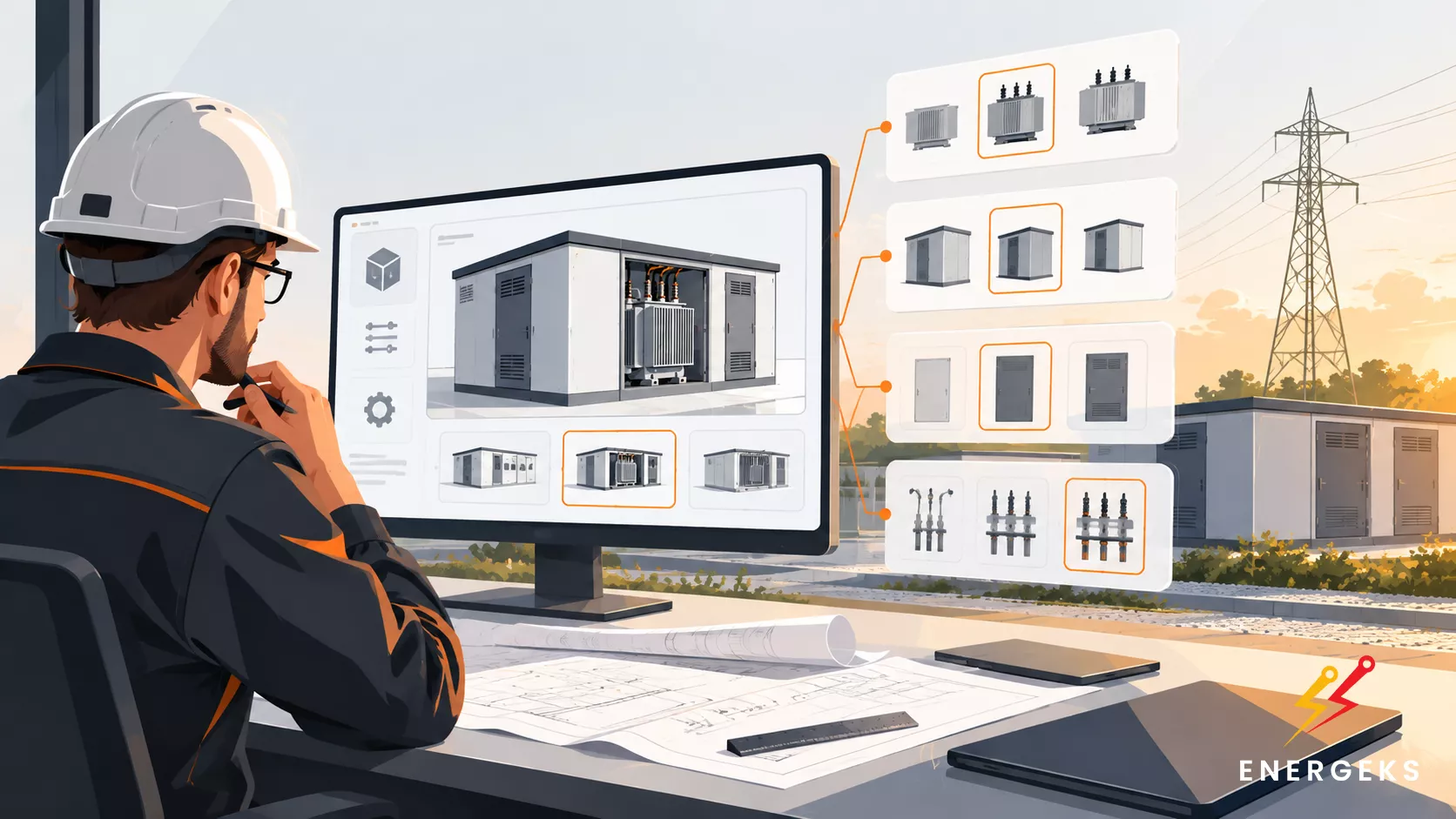
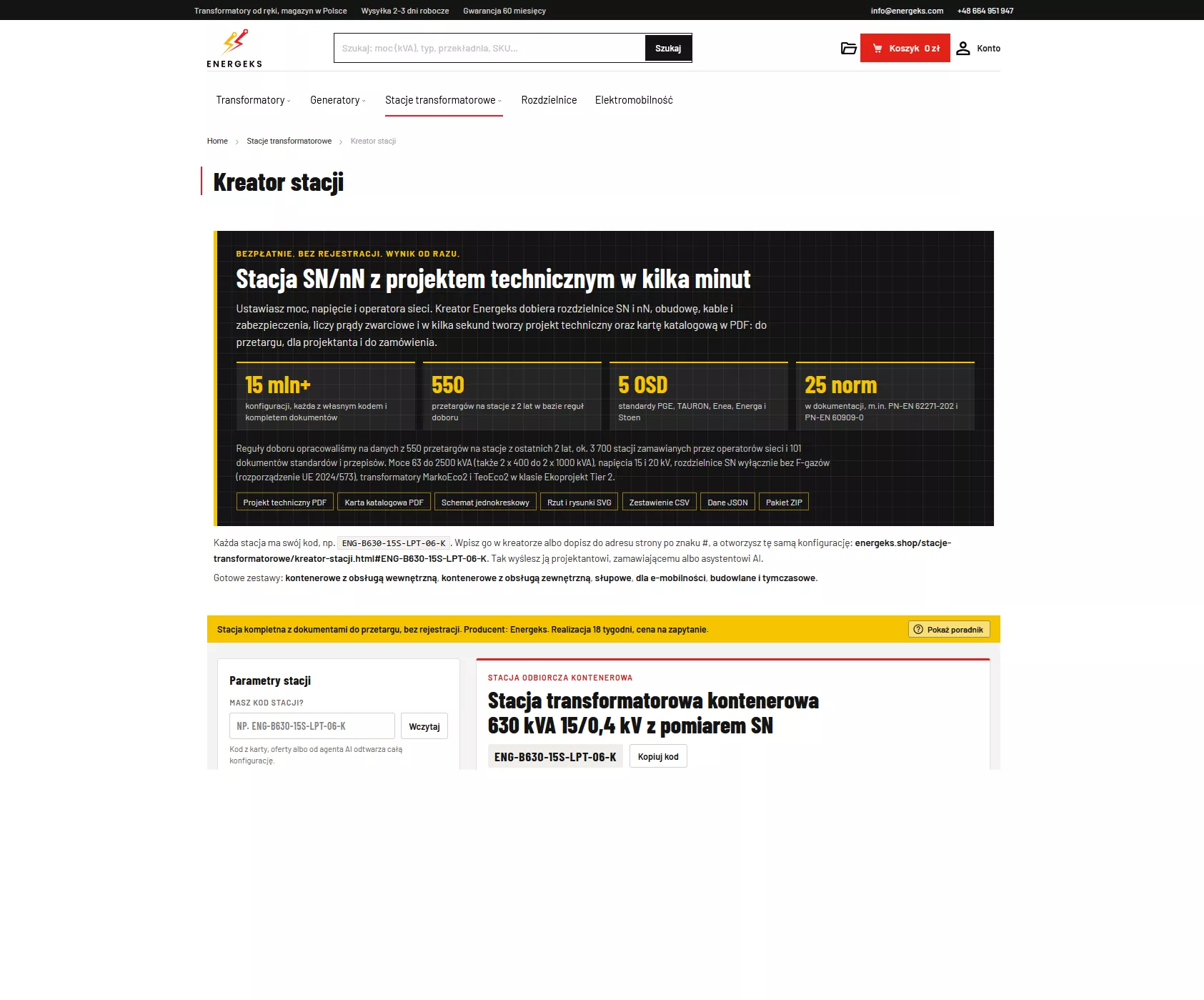
The transformer substation configurator is an online tool that lets you specify an MV/LV substation rated from 63 to 2,500 kVA in six steps: substation type, rating, MV panels, metering, LV switchboard and options. Every configuration gets its own code, and the datasheet, technical design, drawings and bill of materials can be downloaded straight away, with no sign-up. A step-by-step guide is available on the page by default.
On every project with an MV connection there comes a moment when several people need the same substation, each in a different form.
The investor has the grid connection conditions and wants to know the cost. The designer needs a floor plan, a single-line diagram and a description.
The contractor plans the crane, the excavation and the foundation, and the purchasing team compares quotes from several suppliers.
Usually each of them sends a separate enquiry, waits for a reply and receives documents in a different version from the rest of the team.
In this article you will learn:
what the substation configurator is and who saves the most time with it,
how to complete a configuration in six steps,
which substation type to choose: pole-mounted, compact or walk-in,
how to read a substation code, e.g. ENG-B630-15S-LPT-06-K,
which documents you can download and what they are for,
what to check before the code goes to the designer and the DSO.
The transformer substation configurator is Energeks' online configurator for MV/LV substations.
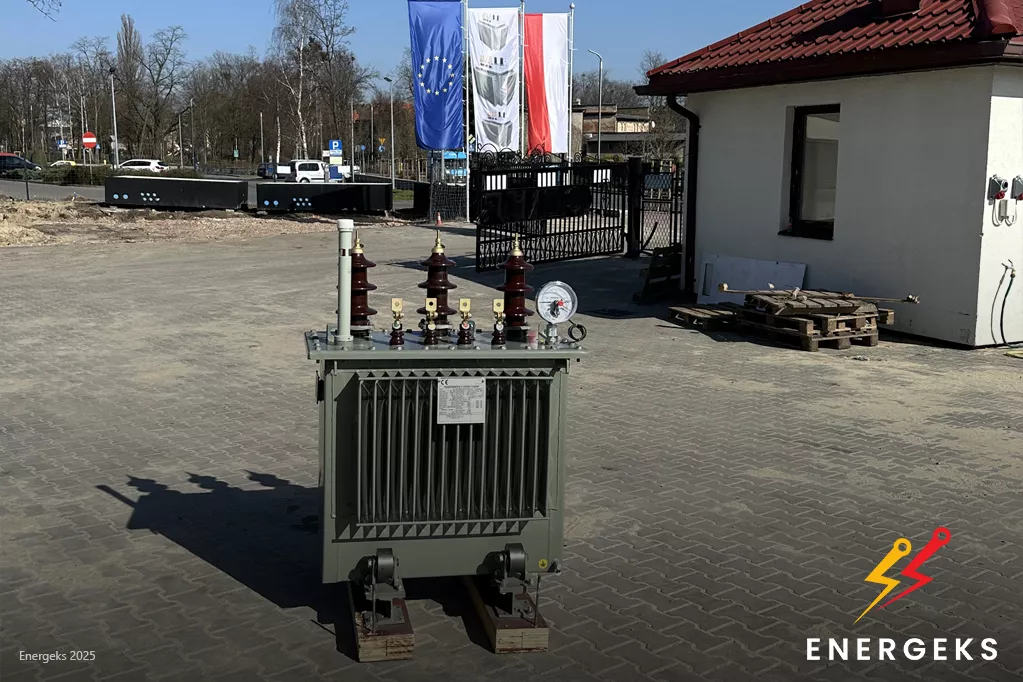
It covers concrete-enclosure container substations, compact substations, pole-mounted substations and substations for e-mobility. At the heart of each one is a MarkoEco2 oil-immersed transformer or, where the design calls for it, a TeoEco2 cast-resin dry-type transformer.
The principle is simple.
You enter the rating, the MV panel layout, the metering type, the number of LV outgoing feeders and any additional options.
The configurator selects the switchgear, enclosure and fittings to match, and assigns a single code to the whole configuration.
That code comes with a complete set of documents, which you download without creating an account.
The configurator does not replace the designer.
What it does replace is the stage where the designer, the contractor or the purchasing team waits for the first version of the floor plan and the equipment list.
The biggest time savings go to design offices preparing several variants of one project, general contractors, substation rental companies and investors getting ready for a tender.
The configuration follows the same order in which a designer thinks about a substation: from the MV network, through the transformer, to the LV loads.
Substation type. Pole-mounted next to an overhead line, compact with external operation, walk-in container with an operating corridor, e-mobility substation or construction site substation.
Transformer rating. From 63 kVA in a pole-mounted substation to 2,500 kVA in a substation for chargers. This is also where you set the target rating if the site is going to grow.
MV panels. Line panel (L), metering panel (P) and transformer panel with fuses (T) or with a circuit breaker (V). A substation looped into a cable line gets two line panels.
Metering. Semi-indirect on the LV side for lower ratings or billing metering on the MV side. LV metering is usually possible up to 160 to 400 kVA, depending on the DSO.
LV switchboard. The number of NH outgoing feeders, from 2 in a pole-mounted substation to 16 in an e-mobility substation, plus the main switching device.
Options. REI 120 fire-rated design, generator panel, fire brigade switch, power quality analyser, no-load compensation and telecontrol at three levels: preparation (T1), fault passage indicators FPI (T2) or remote control (T3).
MV switchgear in Energeks substations contains no F-gases.
Insulating and arc-quenching medium without fluorinated greenhouse gases (e.g. air, solid insulation, natural gases), in line with Article 13(9) of Regulation (EU) 2024/573. You do not need to set this parameter, because every configuration meets it.
Three things decide the choice: the rating, the type of MV network at the connection point and the standard of the DSO that will take over the substation.
Walk-in substations with an operating corridor are part of the standard of some Polish DSOs, e.g. Tauron. Enea Operator and Stoen Operator use compact substations. Enea does not recommend new pole-mounted substations and uses them for refurbishments. We describe the functions of each solution in more detail in the article transformer substations: types, functions and modernisation.
A pole-mounted substation is the choice for ratings from 63 to 630 kVA when an overhead MV line runs nearby. The transformer sits on an E-12 or E-13.5 spun concrete pole, so no building or foundation is needed. It is the cheapest way to connect a small load, which is why it works well on farms, at pumping stations and in workshops.
A compact substation with external operation houses a transformer up to 630 kVA in a KSZ enclosure or up to 1,250 kVA in a KSWz enclosure. The smallest enclosures measure 2.90 x 1.60 m and 2.90 x 2.10 m, weigh approx. 7.5 to 9.6 t and stand on a gravel bed, with no foundation or cable basement. This type is chosen for retail, housing estates, agriculture and small plants, especially where space on the plot is tight.
A walk-in container substation with an operating corridor covers 100 to 1,600 kVA, and in the twin-transformer version from 2 x 400 to 2 x 1,000 kVA. The KSW enclosure is 2.55 or 2.96 m wide. For 630 kVA that means approx. 21 t of concrete and a cable basement under the entire substation. In return, all switching is done under a roof and there is room for MV metering, telecontrol and future expansion. It is the typical choice for factories, hospitals and logistics centres.
An e-mobility substation starts at 630 kVA and goes up to 2,500 kVA, and in the twin-transformer layout from 2 x 630 to 2 x 1,000 kVA. It has an operating corridor and an LV switchboard with up to 16 outgoing feeders, so each charger has its own protection. From 1,600 kVA the enclosure is designed individually. These substations supply electric bus depots, charging hubs and delivery fleets.
A construction site and temporary substation is most often a compact substation from 250 to 630 kVA, and on large sites a 1,000 kVA substation. The body with its base is transported in one piece, and two line panels allow it to be looped into an existing MV line. When the works are finished, the substation can be moved to the next site or left in place as the permanent substation for the building. It is used by general contractors, substation rental companies and sites that need backup power.
The difference between a compact and a walk-in substation is not only about price.
In a compact substation each compartment has its own door, so switching and meter readings are done with the door open, in the rain and in winter too.
In a walk-in substation everything happens under a roof and there is room for MV metering, a meter cabinet and spare panels.
The trade-off is a larger plot, heavier transport and an excavation for the cable basement, with the foundation base approx. 0.9 m below ground level.
Why small enclosures are becoming more popular is covered in our article on mini transformer substations.
At first glance the code looks like a serial number, but it can be read like a short technical description. Take a 630 kVA walk-in substation: ENG-B630-15S-LPT-06-K.
B630: transformer rating 630 kVA.
15S: MV network voltage 15 kV.
LPT: MV panels, i.e. line, metering and transformer panel with fuses. LPV stands for a transformer panel with a circuit breaker, LLT for a loop-in layout with two line panels.
06: number of outgoing feeders in the LV switchboard.
K: enclosure with an operating corridor. KT1 is a corridor with telecontrol preparation, and KD1000 a 630 kVA substation prepared for a 1,000 kVA transformer.
The most practical feature of the code is that it is saved in the page address. A link with the code opens exactly the same configuration, so instead of describing the substation in an email, you simply send the link to the designer, the site manager or to us.
For each configuration the configurator prepares five types of material. Each one goes to a different person on the project.
Datasheet: for the tender and for comparing quotes, with the substation parameters in one place.
Technical design for adaptation: the starting point for the designer, who adapts it to the plot and the connection conditions.
SVG and DXF drawings: DXF opens directly in CAD software, with no need to redraw the floor plan.
DOCX description: editable text for the technical description of the design.
XLSX bill of materials: equipment list for the cost estimate and the purchasing team.
In practice
The floor plan from the configurator is indicative: the equipment layout is confirmed in the design. The documents are best treated as a reliable starting point. In a single day they let you compare, for example, a 630 kVA compact substation in a 2.90 x 2.10 m KSZ enclosure with a 2.55 x 4.00 m KSW walk-in substation, before anyone orders a survey map for design purposes.
Target rating. If the plant is going to add a hall in three years, it is better to record that from the start. The target rating option prepares the enclosure, oil pan, busbars and LV connections for a larger transformer. Replacing a 630 kVA unit with a 1,000 kVA one then does not require rebuilding the whole substation. For target ratings from 800 kVA, we use MK 5 flat clamps instead of TOC clamps. We show how this works in large plants in our article on transformer substations in heavy industry.
Chargers and harmonics. DC chargers generate higher harmonics, so the transformer and protection need to be sized with a margin. In e-mobility substations it is worth considering two transformers with two LV sections. Servicing one transformer then does not shut down the whole depot, and a power quality analyser will show what is happening to power quality.
Metering and the DSO. LV metering is cheaper to build and to bill, but usually only up to 160 to 400 kVA. Above that limit the configurator selects an MV metering panel, and a large connection capacity means additional arrangements with the grid operator.
Note
It is worth ordering the substation well in advance. This applies especially to a construction site substation. Each relocation to a new site requires a crane, disconnection by qualified electricians and a new approval from the DSO.
A well-configured substation is one that nobody has to think about five years later.
Inside it runs a MarkoEco2 oil-immersed transformer with losses compliant with Ecodesign (Tier 2) and a 60-month warranty. Its LV bushings carry TOC-1 clamps with OZNN covers.
The remaining fittings can be found in the transformer accessories category.
The first step takes a few minutes: open the configurator and see what the substation for a specific project looks like.
Products for this configuration
MV/LV substation configurator
Configuration from 63 to 2,500 kVA with a substation code and a full set of documents.
Open the configurator · Ready-made sets
MarkoEco2 transformer
Hermetically sealed oil-immersed unit, Ecodesign Tier 2, the standard transformer in Energeks substations.
TOC-1 transformer clamp
LV clamp for MarkoEco2 bushings, used with OZNN covers.
No. You set up the configuration and download the documents without creating an account. The substation code is saved in the page address, so the link to a finished configuration can be forwarded by email.
We quote prices for ready-made sets on request, because they depend on the enclosure, MV panels, metering and options. For the same rating the difference can be significant: a 2.90 x 2.10 m KSZ compact substation weighs approx. 9.6 t, while a 2.55 x 4.00 m KSW walk-in substation weighs approx. 21 t. The quickest way is to send us the code from the configurator.
Yes. The standard is the MarkoEco2 oil-immersed transformer with a 60-month warranty, and on request we install a TeoEco2 cast-resin transformer.
Usually a walk-in container substation with an operating corridor, from 630 to 2,500 kVA or with two transformers from 2 x 630 kVA. The LV switchboard takes up to 16 outgoing feeders, so each charger has its own protection, and metering is on the MV side.
Yes. Once the target rating is set in the configurator, a construction site substation can remain as the plant's substation after the works are finished, or be moved to the next site.
Mini transformer substations: the future of power distribution
Transformer substations in heavy industry
Send us the substation code from the configurator, or simply a few sentences about the project: rating, location, deadline.
We will refine the rest together. We will check whether the configuration fits the connection conditions and the DSO standard, suggest where to leave headroom for expansion, and prepare a quote that is easy to defend in front of the investor. We like projects where we sit at the same table as the designer and the contractor from day one, because then the substation simply works.
We also share practical site experience, new products and completed projects on LinkedIn. Drop by and stay in touch.
No reviews!